
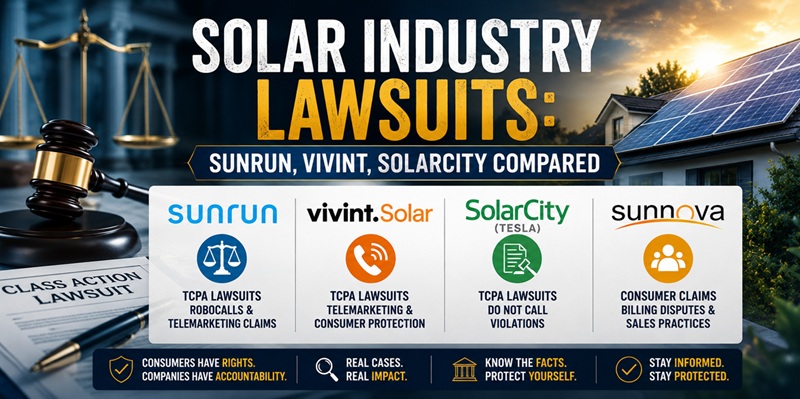

Major solar industry lawsuits include Sunrun’s two $5.5 million TCPA settlements (2019 and 2021), Vivint Solar’s $975,000 TCPA settlement (2019), SolarCity’s $15 million TCPA settlement (2018), and Momentum Solar’s up-to-$30 million TCPA settlement (2025). All cases involved unauthorized robocalls and telemarketing without consumer consent under federal law.
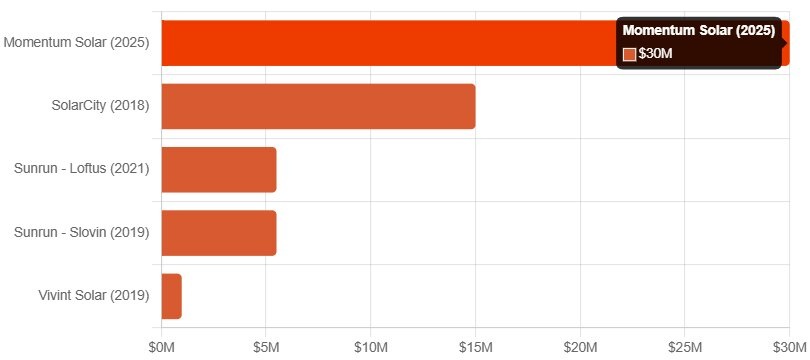
The solar industry has paid out tens of millions in TCPA-related class action settlements over the past decade. Sunrun settled twice for $5.5 million each (2019 and 2021) over alleged robocalls dating back to 2011. SolarCity (now part of Tesla) paid $15 million in 2018. Vivint Solar settled for $975,000 in 2019. Momentum Solar agreed to up to $30 million in 2025 — the largest solar TCPA settlement to date. All companies denied wrongdoing.
The residential solar industry has paid out tens of millions in class action settlements over the past decade — almost entirely tied to aggressive telemarketing practices. Sunrun, Vivint Solar, SolarCity, and Momentum Solar have all faced major TCPA class actions for unauthorized robocalls and unwanted sales contact. This article compares the major solar industry lawsuits, settlement amounts, eligibility windows, what consumers can claim, and how the legal landscape has evolved. Every fact comes from court records, SEC filings, and verified legal reporting — making this a definitive reference for anyone tracking solar industry litigation.
Why the Solar Industry Faces So Many Lawsuits
Solar companies have unique characteristics that drive their high litigation volume.
The Sales Model Problem
Most residential solar companies rely on:
- Mass telemarketing campaigns
- Door-to-door sales teams
- Third-party lead generation companies
- Aggressive follow-up tactics
- High-pressure closing techniques
These practices generate volume — but also generate complaints, regulatory attention, and class action lawsuits.
Why TCPA Is the Most Common Claim
The Telephone Consumer Protection Act (TCPA) allows statutory damages of:
- $500 per negligent violation
- $1,500 per willful violation
For companies making thousands of calls daily, even modest violation rates create massive potential damages. This combination — easy proof of calls + statutory damages + class action mechanism — makes solar TCPA cases attractive to plaintiff law firms.
The Third-Party Lead Generation Issue
Most major solar TCPA cases involve third-party lead generators making calls on behalf of solar companies:
- Media Mix (named in Sunrun case)
- RMC (named in Sunrun case)
- Americor (named in Sunrun case)
- Clean Energy Experts LLC (named in earlier Sunrun case)
Courts have consistently held that solar companies are liable for calls made by third parties on their behalf — making vendor compliance a major industry concern.
Solar Industry Lawsuit Comparison: Quick Reference
Here’s the at-a-glance comparison of major solar TCPA settlements.
| Company | Settlement | Year Finalized | Allegation Type |
|---|---|---|---|
| Momentum Solar | Up to $30 million | 2025 | TCPA robocalls (2 classes) |
| SolarCity (Tesla) | $15 million | 2018 | TCPA + unsolicited calls |
| Sunrun (Loftus case) | $5.5 million | 2021 | TCPA + CA Invasion of Privacy |
| Sunrun (Slovin case) | $5.5 million | 2019 | TCPA robocalls |
| Vivint Solar | $975,000 | 2019 | TCPA unsolicited robocalls |
For complete details on the largest solar TCPA settlement, see our in-depth analysis: Momentum Solar Lawsuit: $30M TCPA Settlement Facts.
Combined disclosed solar TCPA settlements: Over $57 million since 2018.
Sunrun: Two Separate $5.5 Million Settlements
Sunrun has been the most-litigated solar company in TCPA history.
Slovin v. Sunrun (Case No. 4:15-cv-05340)
- Court: U.S. District Court for the Northern District of California
- Plaintiff: Lynn Slovin
- Co-defendant: Clean Energy Experts LLC
- Final approval: July 19, 2019
- Settlement: $5.5 million
- Per-class-member payment: Estimated $100-$250
- Class period: Sept 20, 2011 to Aug 31, 2018
Loftus v. Sunrun
- Plaintiff: William Loftus
- Filed: March 2019
- Co-defendants: Media Mix 365 LLC, RMC, Americor
- Settlement: $5.5 million
- Preliminary approval: September 25, 2020
- Final approval: May 6, 2021
- Class period: Sept 1, 2018 to Sept 25, 2020
Key Allegations
Both Sunrun cases alleged:
- Unauthorized robocalls without express written consent
- Use of automatic dialing systems
- Calls to numbers on the National Do Not Call Registry
- Prerecorded voice messages without authorization
- California Invasion of Privacy Act violations (in Loftus case)
Sunrun’s Position
According to Sunrun’s SEC filings (Form 10-K and 10-Q), the company stated:
- The claims were “without merit”
- Settlement was reached to avoid “cost and risk of continuing to defend”
- No admission of wrongdoing
- Required to implement 4-year compliance monitoring in earlier case
SolarCity (Tesla): The $15 Million Settlement
The SolarCity case set the industry benchmark for TCPA settlements.
Case Background
- Year resolved: 2018
- Settlement: $15 million
- Defendant: SolarCity Corporation (acquired by Tesla in 2016)
- Allegation type: TCPA violations + unsolicited calls
Why It Matters
The SolarCity settlement was significant because:
- It established the price of solar TCPA violations at a major scale
- It came after the Tesla acquisition — Tesla inherited the liability
- It demonstrated regulatory tolerance is limited even for high-profile brands
- It set the framework for later settlements
After this settlement, SolarCity was effectively integrated into Tesla Energy. The brand was retired, but the legal precedent remained.
Visual Comparison: Solar Industry TCPA Settlements Timeline
Vivint Solar: The $975,000 Settlement
The smallest of the major solar TCPA settlements still set important precedent.
Case Background
- Year resolved: 2019
- Settlement: $975,000
- Allegation: TCPA violations through unsolicited robocalls
Why the Settlement Was Smaller
Several factors likely contributed to Vivint Solar’s smaller settlement amount:
- Narrower class definition than other solar TCPA cases
- Shorter class period
- Lower call volume during the relevant period
- Earlier settlement before potential damages could fully accumulate
Vivint Solar’s Acquisition by Sunrun
In October 2020, Sunrun acquired Vivint Solar in a deal valued at over $3 billion. This consolidation:
- Created the largest residential solar company in the U.S.
- Combined the legal histories of both companies
- Made Sunrun the most-litigated solar brand by combined exposure
- Carried forward TCPA compliance obligations from both predecessors
How Solar TCPA Cases Typically Proceed
Understanding the legal flow helps consumers know what to expect.
Standard Timeline
- Initial complaints filed by plaintiffs with documented call records
- Class certification motion to allow class-wide treatment
- Discovery phase — call records, vendor contracts, consent documentation
- Settlement negotiations before trial
- Preliminary settlement approval by the court
- Class notification to potential members
- Final approval hearing with fairness review
- Claim filing period — typically 60-180 days
- Distribution of settlement payments
Why Most Cases Settle
Solar companies typically prefer settlement because:
- Statutory damages can stack quickly at scale
- Discovery exposes internal compliance failures
- Reputational damage continues during litigation
- Insurance often covers significant portions
- Trial outcomes are unpredictable with juries
Common TCPA Defenses in Solar Cases
Solar companies have raised several defenses across these cases.
Frequent Defense Arguments
| Defense | Typical Argument |
|---|---|
| Prior consent | Consumer agreed to be contacted via lead form or partner site |
| No ATDS used | Calls made manually, not by automatic dialer |
| Third-party liability | Lead generators acted independently, not as agents |
| Statutory exception | Established business relationship existed |
| Established consent | Consumer hadn’t revoked permission to call |
Why Defenses Often Fail
Courts have generally been skeptical of these defenses because:
- Lead form consent is often deeply buried in fine print
- Hand-dialed claims are often contradicted by call volume evidence
- Third-party liability has been clarified by Supreme Court rulings
- Business relationships require demonstrable existing customer status
- Consent revocation has been broadly interpreted by courts
Solar Industry Compliance Improvements
The wave of TCPA settlements has driven industry-wide changes.
Common Required Reforms
Settlements often require:
- 4-year compliance monitoring (Sunrun’s required)
- Internal Do Not Call list maintenance
- Vendor contract revisions requiring TCPA compliance
- Consent documentation systems
- Employee training programs
- Regular audits of call practices
- Updated marketing scripts
How Solar Sales Have Evolved
Since the major settlements:
- Many companies have moved to opt-in lead generation
- In-home sales appointments are scheduled rather than cold-called
- Door-to-door sales have replaced some phone outreach
- Online lead capture with clear consent has expanded
- Third-party vendor oversight has tightened
Despite these changes, TCPA cases continue — most recently the Momentum Solar $30 million settlement in 2025.
Step-by-Step: What to Do If You Got Solar Robocalls
If you received unwanted solar marketing calls, here’s your path.
- Document every call with date, time, caller ID, and content
- Save voicemails from solar telemarketers
- Record opt-out requests with date and time
- Save phone bills showing inbound call records
- Register on the National Do Not Call Registry at donotcall.gov
- Check active class actions at ClassAction.org and TopClassActions.com
- File a claim if you qualify for an open settlement
- Report to the FCC at fcc.gov/consumers/guides/stop-unwanted-robocalls
- Report to the FTC at reportfraud.ftc.gov
- Consider individual TCPA action for significant call volume ($500-$1,500 per call)
Warning: Never pay fees to claim TCPA settlement compensation. Real class action claims are always free to file.
Comparison: Pre-Sales Solar Marketing Practices
| Practice | High Risk for TCPA | Lower Risk |
|---|---|---|
| Cold calling with auto-dialer | ❌ Common allegation | ✅ Hand-dial only |
| Pre-recorded messages | ❌ Always violates without consent | ✅ Live agent only |
| Calls to DNC Registry | ❌ Major violation | ✅ DNC screening |
| Text message marketing | ❌ Same TCPA rules apply | ✅ Verified opt-in only |
| Third-party lead calls | ⚠️ Company still liable | ✅ Vetted vendors only |
| Door-to-door sales | ✅ Not covered by TCPA | ✅ Direct in-person |
What This Means for Future Solar Marketing
Industry trends suggest several developments.
Likely Future Developments
- Stricter vendor compliance requirements
- Greater investment in opt-in marketing
- Reduced reliance on outbound telemarketing
- Expansion of door-to-door sales (where allowed)
- More sophisticated consent management
- Tighter FCC enforcement following recent regulatory changes
- State-level legislative responses
Industry Consolidation Effects
Solar industry consolidation (Sunrun-Vivint Solar, Tesla-SolarCity) has:
- Reduced the number of major TCPA defendants
- Created large companies with deep pockets for settlements
- Standardized compliance practices across acquired companies
- Concentrated future risk in fewer brands
FAQs
1. Which solar company has paid the most in TCPA settlements?
Momentum Solar agreed to the largest single settlement of up to $30 million in 2025. SolarCity (now part of Tesla) paid $15 million in 2018. Sunrun has paid two separate $5.5 million settlements (2019 and 2021), totaling $11 million. Combined disclosed solar TCPA settlements exceed $57 million since 2018, making it one of the most-litigated consumer industries.
2. Why are solar companies sued for telemarketing so often?
Residential solar relies heavily on outbound telemarketing and third-party lead generation, creating large call volumes. Combined with TCPA’s statutory damages of $500-$1,500 per call, this generates significant exposure when consent documentation is weak. Solar’s emergence during the rise of automated calling technology has compounded these risks for major industry players.
3. Can I still file a claim in any solar TCPA settlement?
It depends on the specific settlement. The Momentum Solar settlement (announced 2025) is the most recent and may still have claim filing periods open. Earlier settlements like Sunrun (2019, 2021), SolarCity (2018), and Vivint Solar (2019) have likely closed. Check official settlement administrators or ClassAction.org for current eligibility.
4. What is the Telephone Consumer Protection Act (TCPA)?
Passed by Congress in 1991, the TCPA prohibits making automated calls or text messages to cell phones without prior express written consent, prohibits calls to numbers on the National Do Not Call Registry without consent, and requires companies to maintain internal do-not-call lists. Violations carry statutory damages of $500 per negligent call or $1,500 per willful violation.
5. Did Sunrun’s acquisition of Vivint Solar affect the lawsuits?
The Sunrun-Vivint Solar merger in October 2020 combined the legal exposures of both companies. Existing settlements remained intact, but Sunrun inherited future TCPA risks from Vivint Solar’s marketing practices. The combined entity is now the largest U.S. residential solar provider with the most extensive TCPA settlement history in the industry.
6. Are solar industry TCPA lawsuits still being filed?
Yes. Despite the wave of major settlements, new TCPA class actions continue to be filed against solar companies. The 2025 Momentum Solar settlement covers conduct as recent as January 2025, demonstrating that TCPA violations in solar marketing remain an active legal area. Industry consolidation has reduced defendants but not necessarily the number of cases.
7. How much can I expect from a solar TCPA settlement?
Individual payouts typically range from $30-$500 depending on the settlement fund size, class size, and validity of your claim. Sunrun’s earlier settlement estimated payments between $100-$250 per claimant. The Momentum Solar settlement, with up to $30 million available, may produce similar individual amounts depending on final class size. No-receipt claims often receive smaller payouts than documented ones.
Key Takeaways
- Solar industry TCPA settlements exceed $57 million across major brands since 2018
- Momentum Solar’s up-to-$30 million settlement (2025) is the largest single solar TCPA payout
- SolarCity (Tesla) paid $15 million in 2018, setting industry benchmarks
- Sunrun has paid two separate $5.5 million settlements in 2019 and 2021
- Vivint Solar settled for $975,000 in 2019 — smallest of the major solar cases
- All companies denied wrongdoing but settled to avoid further litigation costs
- Individual TCPA claims remain possible at $500-$1,500 per violation outside class actions

Stay connected